
Stories, tips and solidarity from our community of growers
By George Bennett, Sandy Lane Farm. Collated by Steven Sidhu, Growing Good Technology.
Update from Steve, Mon 10th Aug: It’s set to be another depressingly record-breaking week of hot, dry weather in the UK, with the South of England especially impacted. There remains no meaningful rain forecast in the coming fortnight. This blog contains experience and views from a handful of small-scale growers in our community - George was a little nervous about appearing to tell others about how to cope with the conditions, and from listening to the response we’ve had, there is no ‘right or wrong’ here. So much depends on the crop in question, local weather, infrastructure and equipment, water availability, soil make-up, available labour and so on.
Some growers feel that removing weeds allows any available moisture to be fully utilised by the intended crop, others don’t want risk disturbing the soil and losing precious moisture by weeding at all. As a non-grower, both seem logical to me.
Another observation is that even if you are ‘lucky’ enough to have the infrastructure in place to irrigate in some form - the conditions are by no means stress-free. Watering takes up significant time that would otherwise be spent planting-out, weeding, etc. There are short and long-term consequences of this work not being done, and many are making brave decisions to prioritise the survival of Winter crops while watching Summer veg perish by the day.
In their newsletter last week, Flourish shared an update that captured the challenge our growers are facing this year;
”Everywhere we look, we see the effects of one of the hardest growing seasons we've experienced. Months of drought, relentless drying winds and exceptional heat have tested every part of the farm. Every day the team repairs irrigation pipes, battles to keep crop netting in place against the wind, and works tirelessly to protect crops from new pests and diseases that thrive in hot, dry conditions. We've spent years building healthy, living soils through regenerative farming, yet this summer we've watched those precious soils dry out and even blow away in the wind."
As I reflect further on in the blog, there are some obvious systemic problems that many our small-scale growers face - I hope that through shared experience and learning, we can make progress in addressing some of them together.
----------------------------------
George grows organic veg at Sandy Lane Farm in Oxfordshire and co-founded Growing Good. We asked him to share some experience around coping with heat and drought, and then put the same questions to some of our community from across the UK and Europe.
Over to George.
----------------------------------
June 2020 was one of my darkest days
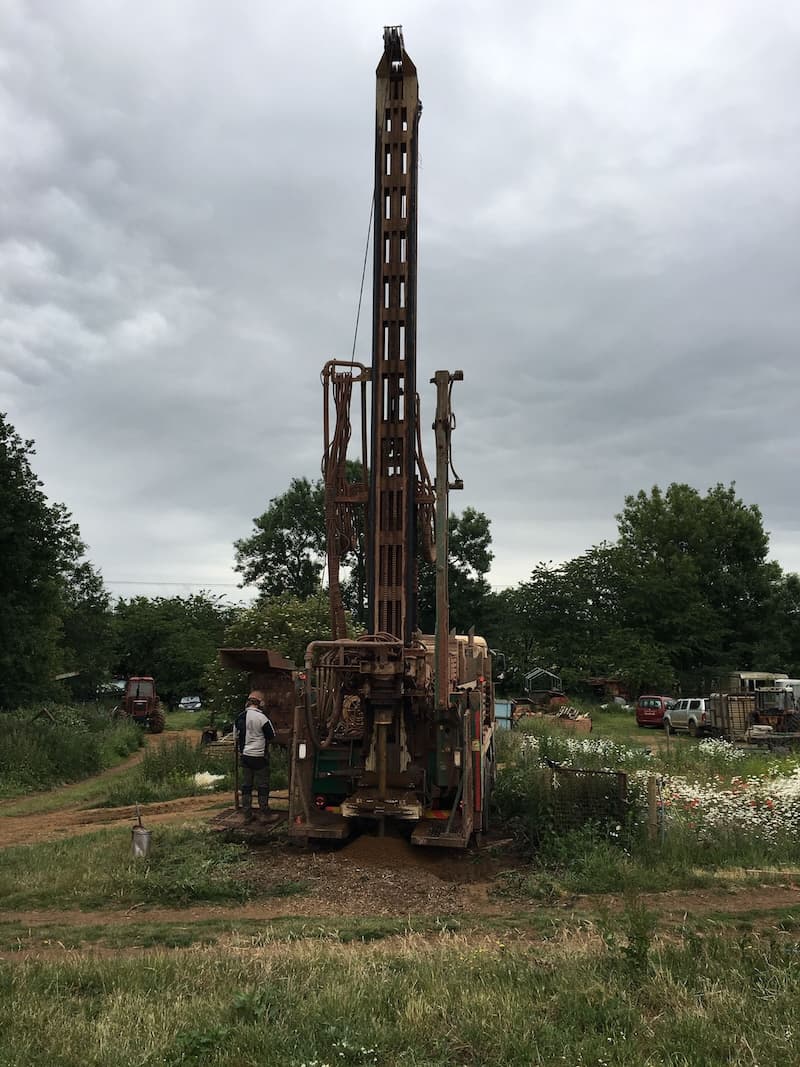
We have free draining sandy soil, we're in a mini catchment basin, and we're nowhere near a river, so any rain that falls soon passes straight through. To secure the future of the farm, we needed water. We were very generously offered the money, as a gift, to dig a borehole. We got the geological survey, got three quotes and finally started digging. It was exciting. They drilled through the green sand, through Oxford blue clay, down to 100m into a deep aquifer, apparently filled up from Wales. Any deeper and it gets salty.
On the third morning, the engineers called me over and said, "It is not viable, and we're capping it off." All those hopes of irrigation plans were in tatters, and what was I supposed to say to the person who'd funded it?
It was a bombshell, and it got the better of me. Steve, with whom I ran the veg box operation, saw me that morning, and I looked like the world had caved in on me.
At a genuine low point, when the future of the farm felt like it had collapsed, Steve gave me one of the most useful pieces of feedback I've received. He told me the farm had been fine yesterday and will be fine tomorrow, so there was no sense in looking as though it had just ended. There are always solutions. I have since learned to deal with those moments in a more constructive way, it's made me better at managing difficult situations.
That learning mattered two years later, in a very different way, but again water was at the heart of it. In the summer of 2022 we had an almost complete crop failure across the board. With virtually no meaningful volume of produce available from the fields, our veg box operation began to support the farm instead. Looking back, I didn't act soon enough. I kept thinking "it is bound to rain at some point," and by the time it got too late to wait, we ploughed dry, dusty soil. We were never going to recover from that; only substantial rain would have rehydrated it.
So I vowed we'd do things differently, that we'd expect there to be no rain and act accordingly. Four years on, we're in a much better place, growing without the safety net of an irrigation rain gun.
Here's what we've learned along the way.
1. Invest in fertility leys and over-wintering green manure. It's extraordinary how much moisture a healthy soil retains through dry periods. A healthy soil biome creates micro-aggregates that act like sponges to hold water.
2. We bought our own plough rather than using a contractor, and we plough early, while there's still plenty of moisture and it's likely to rain again before planting. The contractor still does the big work, but having our own plough gives us a much wider working window.
3. Surface weeding and cultivation matter. Nothing dries out soil like big cracks in the ground. Regular early passes with the steerage hoe break up the surface and act like a barrier that keeps the deeper moisture in.
4. Use onion sets. They'll sit in the ground until they're ready to grow.
5. Direct-drill squash. We use the middle gang of a module planter to get a straight line, run a drip line over each row, and give it a good two hours of water, then nothing else. When they germinate, they're much stronger seedlings and better at fending off slugs, since the roots follow that moisture straight down to find what they need.
6. Beetroot and carrots. Plan in three to five successions, which gives you a much better chance that at least one lands the right balance of moisture and weed control. It's harder with parsnips, since they need to go in the ground early. We use drip tape to get them germinated, and again before a final hand-weed.
7. Brassicas. Don't plant into dry soil if you can help it, wait for rainfall. We've bolstered our early June planting to increase the chance of moist soil, and we cover with mesh immediately after planting. That keeps moisture from evaporating and captures morning dew. If it doesn't rain, the mesh keeps the flea beetle off too; if it does rain, we take the covers off once the plants are established, and the parasitic wasps take care of the caterpillars. Two years running, our June brassicas have had no rain or irrigation and have done remarkably well.
8. Brassicas, later plantings. When there's no rain, we plant only six rows at a time, the width of our covers, so we can cover immediately, then drip-tape irrigate within 24 hours, then repeat with the next six rows. The idea is to get them established so they can reach the soil moisture below and sustain themselves.
9. Build a sales model flexible enough to cope with losses and make the most of what's done well. Veg boxes are a real gem here. Yes, they're complicated and margins are tight, but you have far more control over what sells than you would through farm shops, markets or wholesale. I've been able to use up extraordinary amounts of gluts and quietly cover for any failures in the fields. If I have to, I'll buy in veg to fill out the box contents, so we can keep selling what we do grow alongside it.
So here we are in August 2026. It's been a very tricky season, with no rain for eight weeks. We've had a few casualties, and there might be more to come, but what we've managed with extremely limited water gives me hope for the autumn and beyond.
If we hadn't had that rain at the start of June, it might well be a completely different story. Our plan now is to put in infrastructure to capture winter rainfall. I just hope we don't lose the ethos that comes with using water frugally, getting roots established, then letting them fend for themselves.
Pic below of drilling the 'borehole' in 2020, and at the time of taking, still full of optimism.
You are not the only one
George's eight weeks without rain were not a run of local bad luck. July 2026 was, provisionally, the driest July on record for England and Wales, in a series that goes back to 1836. England had just 6.5mm of rain across the whole month, around a tenth of the long-term average and less than half the previous record set in 1911. Southern England had only 1.9mm, its driest month ever recorded, and nineteen English counties saw a millimetre or less across the entire month. (Figures from the Met Office, 3 August 2026.)
So when we asked the community how they were coping, the answer from many was "not easily".
Josh at Goodery (Norfolk, UK) told us the heat had been brutal. Propagation was worst hit, with newly germinated plants roasted on the hottest days. Salads bolted. The flower-zapping heat in the tunnels and the lack of rain outside meant the usually abundant late-July fruitings didn’t materialise, and he was only just coming good on courgettes, cucumbers and tomatoes.
Kristof at Zsámboki Biokert, near Budapest on the edge of the Great Hungarian Plain, described crop failures from heat stress and lack of water, and a subsequent August cash squeeze as the losses met the usual seasonal dip in orders. His outlook is a proactive, "adapt or die".
The team at Flourish, (Cambridgeshire UK), in a recent newsletter, were just as candid. They named the four things that make a farm most vulnerable mid-season as; losing people, machinery breakdown, temperature extremes and a lack of water, and said they were living all four at once. Every watering decision now comes down to protecting the carrots, beetroot, cabbages and purple sprouting they need for autumn and winter. Despite best efforts, they have lost around 60% of everything planted in the last month, and some mature crops are being left so young plants can survive.
From Denmark, Fredrik at Godis Grønt wrote with real feeling for growers here, worried that some might not make it through to next year, and hoping for solidarity from customers and government alike.
Aimee & Will at Living Larder, on the Isle of Wight, are one of the 'lucky' ones, with field-scale irrigation and a pond. That doesn't make things easy though, with a number of veg items suffering;
"I don't think we have consciously sacrificed anything as such, we've just been time limited (by the conditions). The courgettes were in overdrive until last week and we had to increase the portion size (in the boxes), so I expect customers will be pleased to have a break from them. We also sacrificed the second planting-out of courgettes because the time was needed irrigating. The flat beans are in a slightly awkward location so ideally would be on drip irrigation from mains water, this was planned but didn't happen, they are still cropping just as an extra rather than an item in the boxes. The sweetcorn was weedy and so I think we took the decision not to water the weeds and focus on Winter crops which are far more valuable to us than a Summer two week crop - we will still get a pick but we are now deciding if it's worth putting up the electric fence to keep out the badgers! So I guess we have spent a lot of time irrigating and have made the decision to focus on winter crops, rather than Summer when we have plenty to choose from to fill the boxes.
We still have water in the pond, so we aren't worried at the moment. The field scale irrigation is time consuming, with long days, pretty much every day for the past 6 weeks."
Taking action
How are we coping? Grouped loosely by theme;
Soil
Joshua at Little Marcle (Herefordshire, UK) makes the case for diverse cover crops, terminated in good time. He passed on two lines from his family. His Dad's advice is to roll any ploughing straight away to reduce the surface area and lock in moisture. His grandad's is shorter, that “a scuffle is as good as water!” Flourish remind us that soils rich in organic matter hold onto water for longer.
Shade and covers
As George describes, intelligent use of covers is now an essential tool in the small-scale, organic grower’s armoury. Josh at Goodery nets as much as he can, to shade the crop and hold moisture. Kristof uses Raschel shade netting on his more vulnerable greens. Flourish use protective netting for moisture retention as much as for keeping the birds off. Joshua at Little Marcle explained why it works, that wind can strip more moisture than sun, so a cover that takes the edge off the wind and lifts the humidity underneath lowers the plant's water stress and leaves more in the soil. Aimee at Living Larder nets anything she has irrigated, both to hold onto that water and to keep the flea beetle off.
Watering
For those with some water, it is about precision rather than volume. Nick at Sheffield Organic Growers has laid out drip tape and waters overnight on a timer, four hours to a group of beds, losing less to evaporation. Zsamboki have dug wells and built storage ponds for a few days of buffer, and are moving from overhead to drip. Fredrik uses a third of water in his mulched system vs planting in bare-soil, and Flourish note that drip uses under a third of the water of more conventional methods.
Route to market
A flexible route to market came up more than once. George leans on the veg box to cover for gluts and gaps. Kristof buys in from partners in cooler parts of Austria to keep the salad flowing when his own bolts, which, as he says, dents margin but keeps the boxes going.
The bigger picture
Stepping away from the field, the growers who have been through it before tend to see this not as a freak year, but as a pattern to be planned for. Fredrik's first season on his own land was the Danish drought of 2018, and it taught him early that a deep well and water-saving systems had to come first if he wanted to last. By the next big dry spell, in 2023, that investment turned a potentially difficult year into one of his best. Kristof's "adapt or die" is the same view worn a little more raw.
As Flourish articulate so well, regenerative farming genuinely helps. Healthier soils hold more water, greater biodiversity builds resilience, diverse cropping spreads the risk. But it is not a magic shield. No farming system simply carries on unaffected when the climate shifts this quickly.
This is not a story about individual growers falling short, there is a structural problem that needs addressing. Investing in water resilience, a well, storage, drip tape across more of a land, takes capital and security. Many small growers have neither. Many farm on short-term tenancies where long-term investment feels too risky, and capital is hard to come by for businesses with thin margins and few assets to borrow against. When the advice to growers is to plan and invest, we have to be honest that the system often makes that very hard to do. Fixing the weather is beyond us. Making it easier for growers to build resilience is not, and that is the part we should focus on.
Fredrik, for his part, would discourage newcomers from starting alone in an isolated field, and would push them towards collaborating with established farms and/or other growers that already have the infrastructure. As he puts it, vegetables are around 90% water, so setting-up with no plan for irrigation is a strategy built on optimism.
We're in this together
Josh at Goodery, puts it so well, “Keep in touch with the growers around you who are going through the same thing. It is easy to feel overwhelmed by the heat and related setbacks, but much easier when you realise it is happening to everyone.”
Fredrik signed off his message by sending good thoughts, and some heavy rain clouds, westward across the North Sea. Our UK community will no doubt welcome both!
With thanks to everyone who wrote in.
George and Steve
Growing Good Technology provides software principally to small-scale organic growers. We are on a mission to strengthen local food systems by giving small-scale businesses the tools needed to thrive - to be commercially successful and remain true to their values